What if the most meaningful thing you wore on your wedding day wasn't chosen - but written?
There is a version of wedding styling that begins and ends with aesthetics. You find a beautiful lehenga, you pair it with the right jewellery, you choose flattering colours, and you look stunning. That work matters. I do it, and I do it well.
The Function That Demanded a Story
But then there are the rare projects - the ones that arrive differently. The ones where a couple walks in and, without quite knowing how to say it, asks for something more. Something that couldn't exist for anyone else. Something that, twenty years from now, they could look at and feel everything all over again.
Jinal and Pinak's wedding carnival was one of those projects.
Carnival functions occupy a special place in the Indian wedding calendar. Unlike the ceremony itself, which carries the weight of tradition and ritual, the carnival is permission - permission to be playful, experimental, maximalist, and above all, joyful. Colour is not just welcome; it is expected. Creativity is not just appreciated; it is the point.
When Jinal and Pinak came to me, I understood immediately that this function was not the place for a beautiful-but-generic look. This couple had a relationship built on experiences - real, specific, deeply felt experiences that spanned continents and years. A generic outfit, however stunning, would have felt like a costume. What they needed was a garment that could hold their story.
That is the brief I brought to designer Aishwarya Raka.
.webp)
%20(1).webp)
%20(1).webp)
The Groom
Great design always begins with a conversation about meaning. Before a single sketch was drawn, before a single fabric was sourced, we sat with Jinal and Pinak and asked them to tell us about themselves. Not their style preferences. Their life.
What emerged was a love story that unfolded across cities and cultures with the kind of specificity that only real love produces. There were the Hong Kong train journeys - a city that meant something particular to them, with its layered, kinetic energy. There were holidays in Mexico, vivid with colour and warmth. There was the quiet tenderness of picking tulips together, the concentrated ritual of exploring teas, the daily comfort of coffee and chaat. There were weekends at F1 circuits, shared in that particular way where being together becomes the main event, not the race. And woven through all of it, the ordinary intimacy of a shared love for food - the restaurants, the street corners, the meals that become memories without either person noticing.
Then there were the milestones. The proposal. The wedding venue they had chosen together. The rings. The date that would mark the beginning of the next chapter.
All of it, we decided, would live in the fabric.
This wasn't a mood board exercise. This was archaeology - excavating the texture of two people's shared life and asking: what does this look like as craft? Aishwarya Raka answered that question with extraordinary precision. Every motif was considered, every embroidered detail deliberate. Nothing was decorative for decoration's sake. Each element earned its place because it was true.
%20(1).webp)
The Groom: Pinak
Pinak wore a butter yellow jacket and trousers set with a crisp white T-shirt - and the choice of butter yellow was not incidental.
In the context of a carnival function, yellow carries a particular charge: it is celebratory without being loud, vibrant without being aggressive. It communicates joy in the most immediate, sensory way possible. Against the festivity of a carnival setting, butter yellow reads as warmth itself. It is a colour that draws people toward you. It is a colour that photographs like a feeling.
But the colour was only the beginning. The silhouette was deliberately clean and modern - structured enough to feel intentional, relaxed enough to feel like him. The jacket was cut to move well, to look effortless across a halfway celebration. No unnecessary embellishment in the structure itself, because the embellishment, in this case, had an entirely different purpose.
His jacket was not decorated. It was illustrated.
Working with Aishwarya Raka's extraordinary craftsmanship, the fabric became a canvas on which the chapters of their relationship were painted and embroidered by hand. The Hong Kong motifs sat alongside tulip-inspired embroidery, which gave way to F1 details rendered with enough specificity to be unmistakable. Tea exploration translated into delicate botanical references. Coffee cups and food illustrations appeared in the kind of joyful, graphic style that felt true to who they are. The proposal moment - the moment before the marriage - was given its own space on the fabric. So was the wedding venue, rendered as architectural artwork. And in the quietest corner of the jacket, barely visible unless you knew to look, their wedding date and ring design were woven in.
You could look at this jacket from across the room and see a beautiful, confident piece of festive menswear.
You could look at it up close and read a love story.
%20(1).webp)
What Emotional Couture Actually Means
I want to be precise about what this kind of work is - and what it isn't.
Personalisation in fashion is not new. Monograms exist. Initials get embroidered. Couples incorporate their wedding date somewhere. These are lovely gestures, and I do not dismiss them. But they are gestures. What we created for Jinal and Pinak was something categorically different: a garment in which the personal detail is not an addition to the design, but the source of it. The love story is not ornamental. It is structural. Remove it, and there is no jacket. There is only cloth.
It is styling that begins not with a mood board but with a relationship.
This is what I mean when I call it emotional couture. It demands a different kind of listening - the kind where you are not trying to extract information about preferences, but trying to understand what a person's life actually looks like and feels like. It demands a collaboration between stylist and designer that goes beyond briefing notes and fabric swatches. And it demands a couple brave enough to let their private story become something wearable, visible, shared.
Jinal and Pinak were that couple. Aishwarya Raka was that designer. And I am grateful I got to be the person who held the thread between them.
%20(1).webp)
%20(1).webp)
A Note for Every Couple Reading This
Your relationship has a texture. It has specific places and specific moments and specific habits that are yours alone - that belong to nobody else on earth. Those things are not too small to matter. They are, in fact, the most important things.
The next time you sit down to plan your wedding look, I want you to ask not just what you want to look like, but what you want your outfit to say. About who you are. About who you became together. About the years before the wedding that made the wedding worth having.
If the answer to that question leads you somewhere unexpected - somewhere more personal, more specific, more yours than anything you have seen on Pinterest - follow it.
That is where the most beautiful work happens.
%20(1).webp)
Explore more at stylistsrushtee.com | Follow on Instagram: @stylist.srushtee
Concept and styling by Srushtee Misal | Custom look by designer Aishwarya Raka
Ready for Your Perfect Wedding Look?
Book a consultation and let's create a wedding wardrobe that tells your unique story.
Book Wedding StylingMore Posts You'll Love
Written by
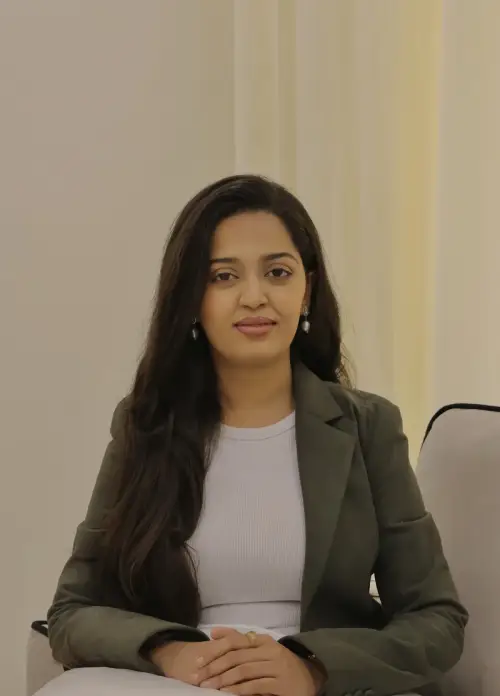
Srushtee Misal
Founder & Lead Stylist at Stylist Srushtee
Srushtee Misal is a NIFT Kangra-trained personal stylist and wedding stylist based in Pune, India. With 120+ wedding looks curated and brand collaborations with Marks & Spencer, Van Heusen, and Lifestyle, she specialises in luxury bridal styling, wardrobe transformation, and color analysis. Featured in Mid-Day as a Wonder Women Entrepreneur of India (April 2026).
Read Full Bio